Cruising with Alzheimer’s: AirTags, Happy Hour, and a Whole Lot of Patience
A Viking cruise from Athens to Barcelona taught me that traveling with Alzheimer’s takes extra patience, planning, compassion—and apparently, at least one AirTag. ❤️
Ted booked our Viking cruise almost a year in advance.
Athens to Barcelona.
Beautiful ports. Good food. Shore excursions. Happy hour.
Perfect.
Then, about a month before the trip, reality hit me.
We were traveling with dear friends, and the wife was living with Alzheimer’s.
Suddenly, I realized something very important:
I was no longer the only crazy person Ted had to worry about on vacation.
Poor Ted.
Normally, keeping up with me is already a full-time position.
I am not one of those glamorous travelers who strolls off the ship with nothing but sunglasses and confidence.
No, ma’am.
I have a bag.
A water bottle.
Emergency supplies.
Random things nobody asked for.
And enough backup plans to qualify me for FEMA.
So, before this trip, I bought an extra tracking device.
For her?
Technically.
For my sanity?
Absolutely.
We attached an Apple AirTag securely, so we had an extra layer of reassurance in case we got separated.
Did we plan to lose her?
Of course not.
But I also don’t plan to lose my phone, sunglasses, passport, purse, or dignity on vacation, and yet here we are.
Bathroom breaks suddenly became tactical operations.
“Where is everybody?”
“Who went inside?”
“Who is waiting outside?”
“Did Ted go with them?”
“Why am I standing here holding three water bottles?”
Normal cruise stuff.
First Mission: Garlic
Our friend also had a food allergy.
Interestingly, even with Alzheimer’s, she still remembered it.
The brain is truly something.
So, on the very first day, we found the dining manager and explained that she needed garlic-free meals.
The Viking crew was wonderful.
They arranged a special preset menu for her.
Meanwhile, the rest of us were staring at menus for twenty minutes, debating between lamb and fish like our decision would affect international relations.
Her dinner?
Handled.
Honestly, she may have had the better system.
Shore Excursions Became a Group Project

Every day, the four of us went together.
Nobody wandered off solo.
Nobody decided, “I’ll meet you later.”
Later where?
In Rome?
At the Colosseum?
On another continent?
Absolutely not.
At the beginning of each tour, we discreetly told the guide that our friend had Alzheimer’s and asked them to keep an extra eye on her.
It worked well because everyone knew what was going on without making her feel singled out.
That part mattered.
Before Alzheimer’s, she traveled.
She had dinner.
She went to happy hour.
She explored.
She had a life.
And just because her memory had changed didn’t mean she had stopped being a person who deserved to enjoy those things.
Waiting Was… Interesting
Waiting lines were probably one of the biggest challenges.
Ten minutes could feel like an hour.
A fifteen-minute drive could become a major event.
Anything longer?
Pray.
One minute, she could be perfectly pleasant.
The next minute, irritation.
Then a little while later, everything was fine again.
At first, it was easy to think, “Oh my goodness.”
But then I had to remind myself:
We understood why we were waiting.
We knew where the bus was going.
We knew how long the drive would be.
She did not always have that same sense of certainty.
That realization changed the way I looked at her reactions.
It did not magically give me unlimited patience.
Let’s not get ridiculous.
I am still human.
And menopausal.
But I became more compassionate.
Her Husband Was the Real MVP
One of the things that affected me most on our trip was watching her husband care for her.
He dressed her every single day.
He chose her clothes, helped her get ready, watched over her, kept track of meals, repeated things when needed, and stayed close through every excursion.
And he did it so naturally that he never made her feel like a burden.
That is the part of caregiving that people do not always see behind the vacation pictures.
Honestly, some of us can barely get ourselves dressed and downstairs for breakfast on time. He was getting two people ready every single day.
That man deserved a medal. ❤️
Watching him taught me that Alzheimer’s caregiving is not just about safety.
It is also about dignity, patience, routine, and love.
And We Still Had Fun
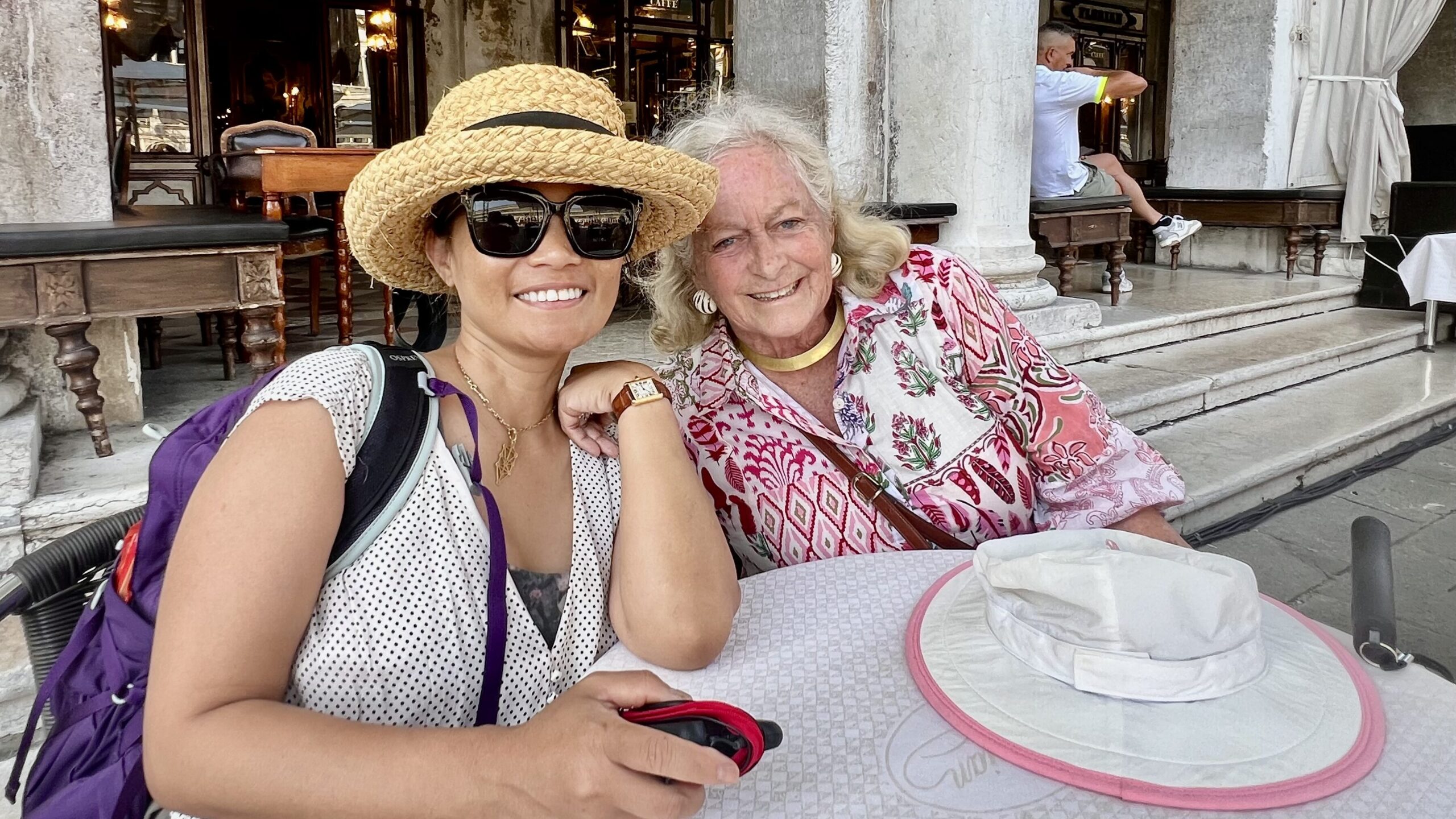
Here is what surprised me most:
We still had a wonderful trip.
We had dinner together.
We went to happy hour.
We toured beautiful places.
We laughed.
We took photos.
We made memories.
Yes, we had to travel differently.
We needed more patience.
More planning.
More communication.
More bathroom coordination.
And, in my case, more technology.
But life did not stop.
That trip taught me something important.
Sometimes we become so focused on what a person can no longer do that we forget to notice what they can still enjoy.
A diagnosis does not automatically mean:
Stay home.
Stop traveling.
Stop having fun.
Stop living.
Of course, every person with Alzheimer’s is different, and travel will not be appropriate for everyone or at every stage.
But when possible, the goal should not always be perfection.
Sometimes the goal is simply:
Let’s go enjoy today.
Because memories are complicated.
She may not remember every port.
She may not remember every dinner.
She may not remember every excursion.
But she experienced those moments as they happened.
And that matters.
So yes, traveling with Alzheimer’s requires a little more patience, a little more compassion, a little more organization…
…and apparently, at least one AirTag.
Life goes on.
Sometimes you just have to pack differently.